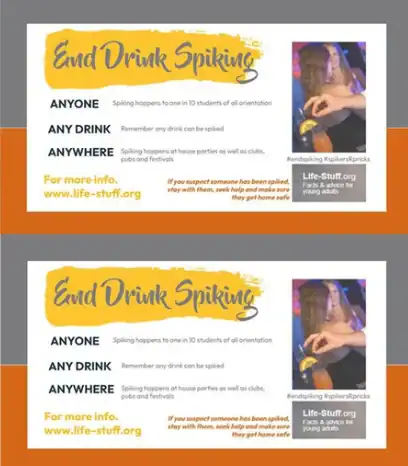
13th April 2026
We are always hoping for new statistics on the prevalence of spiking from the Home Office or police. In the interim, our most reliable sources come from Drinkaware research of more than 7,000 adults, in partnership with Anglia Ruskin University. Spiking is most common in bars (41%) and clubs (28%), with a shocking 75% of incidents going unreported to the police. This is what we are all working so hard on to improve – the confidence to report spiking and seek the support of the police, do a rapid urine test, to test the drink, vape or e-liquid and take the crime seriously. Police forces across the country as well as College and University settings have made huge strides and we are pleased to provide free resources, as well as talks and training as part of our work at The Talk About Trust. Please email kate@talkabouttrust.org to find our more and link to and visit www.life-stuff.org for detailed advice and links.
Prevalence & Demographics: 11% of UK adults report being spiked at some point in their lives. While historically linked to young women, data shows it affects all genders, with 2.2% of adults reporting an incident in the 12 months prior to the 2025 report (around 1–1.2 million people).
Location & Method: Over 60% of incidents occur in bars or clubs, but spiking can occur on holiday at festivals and at house parties.
Reporting & Action: At present only 23%–25% of victims report the incident to the police. Many do not report it because they feel there is no point or out of embarrassment.
Impact & Motives: Victims report feeling woozy, drowsy, or losing consciousness. Witnesses and survivors believe the intent is frequently for sexual assault (87%) or theft (69%).
A chance for spiking victims to have their say
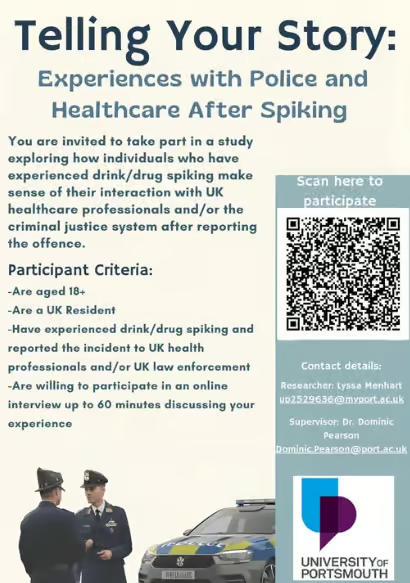
Victims of drink/drug spiking are invited to participate in a University of Portsmouth MSc Forensic Psychology research study exploring the experiences of spiking victims and their subsequent interactions with UK healthcare professionals and/or criminal justice system following reporting the offence. Please refer to the poster below for detailed eligibility requirements. The study involves an online interview via Microsoft Teams lasting up to 60 minutes. This research is conducted by Lyssa Menhart under the supervision of Dr. Dominic Pearson. Your insights will contribute valuable knowledge to this important area of study.
Navigating drink spiking talk
As part of the 2026 Cambridge Festival, Anglia Ruskin University hosted a public talk around spiking on the 21st March. It was delivered by the spiking research team and looks at information around current research and anti-spiking products. We were happy to support the event with our resources. To learn more about Lata Gautam’s work, please email lata.gautam@aru.ac.uk
Free spiking resources available
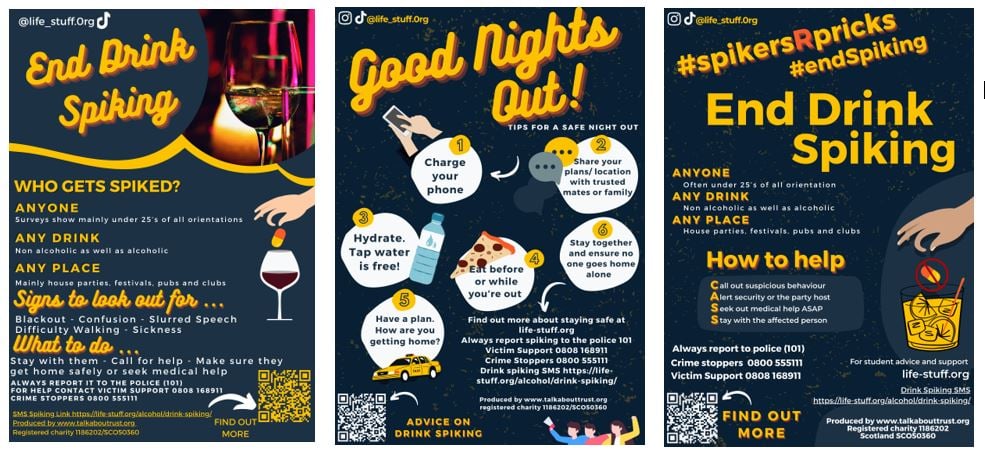
We're pleased to be able to offer our fantastic posters and awareness cards free of charge! We can provide 500 awareness cards and 10x 3 different posters. If you would like more, then modest charges apply. Please email via kate@talkabouttrust.org for more details. Best wishes from all of us at The Talk About Trust Team Regional Staff Contacts: North: kathryn@talkabouttrust.org Midlands and South West: karen@talkabouttrust.org and sarah@talkabouttrust.org London and South East: amy@talkabouttrust.org Scotland: ailsa@talkabouttrust.org